
Credit: NASA, ESA, and M. Durbin, J. Dalcanton and B. F. Williams (University of Washington)
Featured Research
Accurate, Precise, and Physically Self-consistent Ages and Metallicities for 400,000 Solar Neighborhood Subgiant Branch Stars
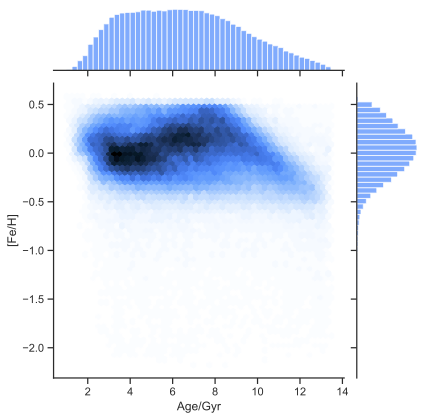
In this study, I inferred the ages and metallicities for 400,000 nearby stars, yielding one of the most robust star-formation histories of the solar neighborhood. These observations challenge our models of stellar evolution and of cosmology, as many of the stars have derived uncomfortably close to the age of the Universe (13.7 billion years).
Optical/Near-Infrared Extinction curve variations toward the inner Milky Way
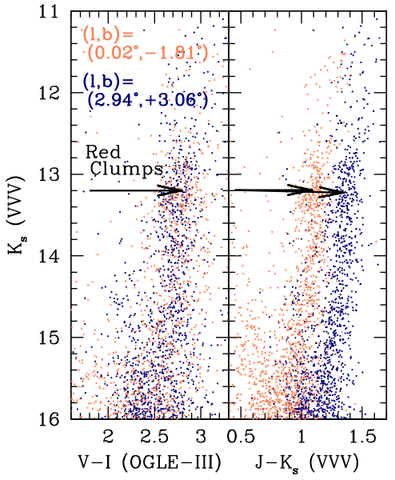
This colour-magnitude diagram is for two sightlines (orange and blue) in two different colours, (V-I) on the left and (J-Ks) on the right. Though the two sightlines show a similar (V-I) colour distribution, they show a distinct (J-Ks) colour distribution, with the ratio differing by 40%. This is indicative of the extinction curve toward the inner Galaxy, which is non-standard in the mean, variable, and has at least two components to its shape.
The star-formation history and helium abundance of the Galactic bulge
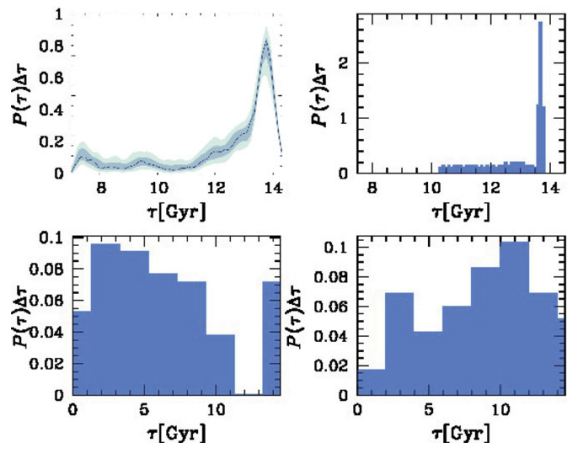
Shown here are the disparate star formation histories of the Galactic bulge. They are fully inconsistent, with mean ages ranging from 3 to 13 billion years. I have speculated that this inconsistency may be due to elevated helium enrichment, due to the fact that it specifically solves the low number counts and high brightness of the red giant branch bump, and the the fact that it can exactly resolve the turnoff age discrepancy. Efforts to further constrain the helium abundance with detached red giant eclipsing binary twins are ongoing.
The nature of multiple populations within globular clusters
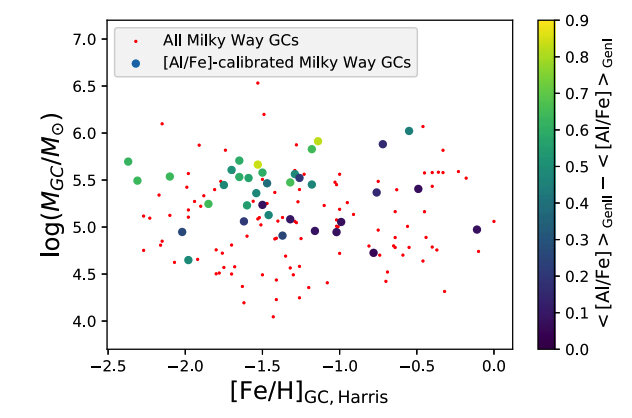
This is a distribution of the Milky Way’s globular clusters in the plane of stellar mass and metallicity, with the aluminum abundance difference between chemically-normal and chemically-peculiar stars colour-coded. In general, the more metal-poor and the more massive clusters have greater aluminum enrichment, which suggests contributions from two non-supernovae chemical polluters that were active in the early universe. The scaling with metallicity is not surprising and likely a consequence of hot-bottom burning in massive asymptotic giant branch stars. However, the scaling with stellar mass is of an unknown origin.